Latest Posts

The Takeaways

Last week’s portfolio review at the Bronx Documentary Center was both informative and rewarding.  In blocks of 15 minutes each, I met and showed samples of my work to five different photo editors from The New York Times, The New Yorker, and Getty Images.  I joked with a few of them that the experience of moving from table to table after such rapid conversations reminded me of speed dating.  All were very supportive of my photographic work on the Harlem River Valley.  They agreed that I had a solid command of the fundamentals: composition, exposure, clarity, and use of light.  A few commented that I was offering a view of the city that isn’t seen very much and that my passion for this subject was evident in the consistency and scope of my images.

At the same time, they each offered instructive criticism of specific images and my portfolio as a whole.  Firstly, it would be wonderful to have more images closer to the waterfront itself.  I have many bridge shots in which the spans are celebrated in a grand, romantic way, but few in which the focus is on the river itself, its banks, or activity around where the river and land meet.  Secondly, people!  It’s true I’ve largely avoided people in my work, but they – even a single individual (perhaps from a distance) – can really help to tell a story, I was told.  Especially with photographs of the natural landscape, people can transform an ordinary image into a captivating and memorable moment.  Finally, emotion!  My photographs were described by one editor as “placid.”  He recommended I try to imbue emotion into my images, which he admitted was challenging to achieve but would help to grab the viewer more easily.  On the other hand, another photo editor seemed to like the calmness of my work.  Thus, one important takeaway from last Saturday’s portfolio review is that among editors there can be a gambit of opinion.  In fact, to help allay any concern that I may have had about some of the editors’ criticism, one of them warned me about this directly.  There’s the opinion of the artist and then, there’s that of the reviewer, she went on to tell me.  One should certainly seek and consider editors’ feedback but shouldn’t take it as gospel (unless they’re the employer or client).

I also befriended other photographers some of whom are full-time professionals and others, who like myself, are not professional but are aspiring to develop and improve their work.  It was wonderful to make these contacts and to learn from people, who are so seasoned and knowledgeable.  I used almost all of the business cards that I brought with me.
Upcoming Portfolio Review

tumblr_mhgufnt6651qlidg4o1_1280

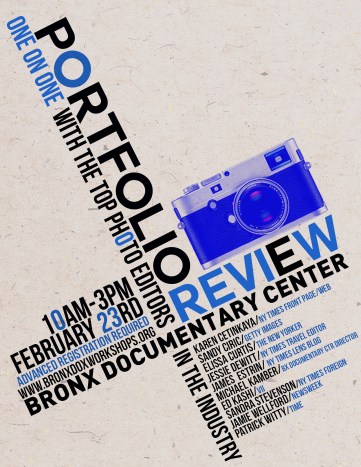
This past weekend I registered for a February 23rd portfolio review at the Bronx Documentary Center, which is located in the HUB section of the Bronx just east of 149th Street.

I went to my first portfolio review one evening back in 2009 at the School at International Center of Photography.  Reviews were being offered as part of an open house event for photographers interested in enrolling in courses there.  I remember that the gentleman, who looked at my work, was impressed by its scope and content but he encouraged me to purchase a DSLR camera  – so that the quality of my images would be significantly better – and then, to reshoot many of those same subjects.  At the time, I was using my 6 megapixel point-and-shoot Canon PowerShot A700.  His recommendation was perhaps the greatest takeaway for me.  While it was some time before I was able to upgrade my gear, it marked a significant step forward in my photographic development.

So, this brings me to this coming Saturday.  I learned about the Bronx Documentary Center a few months ago and have been reading about some of the wonderful work and exhibitions that it has been involved in.  I have been waiting for the right moment to check it out and introduce myself.  Therefore, this portfolio review couldn’t have come at a better time.  On Saturday, I will have the opportunity to meet and share samples of my work with well-seasoned professional photographers and editors from The New York Times, Getty Images, The New Yorker, Newsweek, and other preeminent organizations.  As a Bronx artist who is yearning to gauge whatever potential interest there may be in my Harlem River Valley project, I’m hopeful that my review with this local audience will turn out to be very productive and instructive.

Now that my website is live finally, I feel ready to begin sharing my work with a larger audience in a more serious way than I have in the past.

It’s Alive!

Finally!  After almost seven months of working on my online photography portfolio, it’s finally alive: www.duanebaileycastro.com

Not wanting to ruin the party, a few loose ends remain, however.  For example, I need to upload a couple more images to my “Travel” section.  Nevertheless, it’s a huge relief to finally make the website public after countless, tiring hours at my computer.  I’ve been so fixated on creating the best possible viewing experience possible.

I hope you enjoy it and I look forward to your responses!

It’s Official!

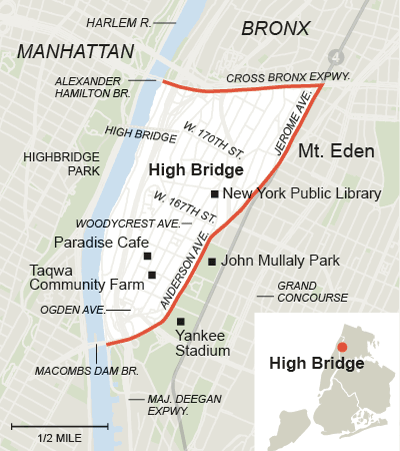
So, it’s official!  The High Bridge will in in fact be restored and reopened.

On Friday, January 11th, Mayor Bloomberg along with city officials, such as my Congressman Jose Serrano, gathered at the Highbridge Park’s Bronx entrance to the span to announce the groundbreaking of this historic crossing.  According to DNAinfo.com, the $61 million dollar project is expected to be completed in 2014.

This past Saturday evening, I photographed the span from the Harlem River Speedway and it was clear that the restoration work had begun.

On a very sad note, however, only a few days after the mayor’s announcement an engineer working on the bridge fell and died.  The cause of his fall is still under investigation.

A Bird’s Eye View above the Harlem River

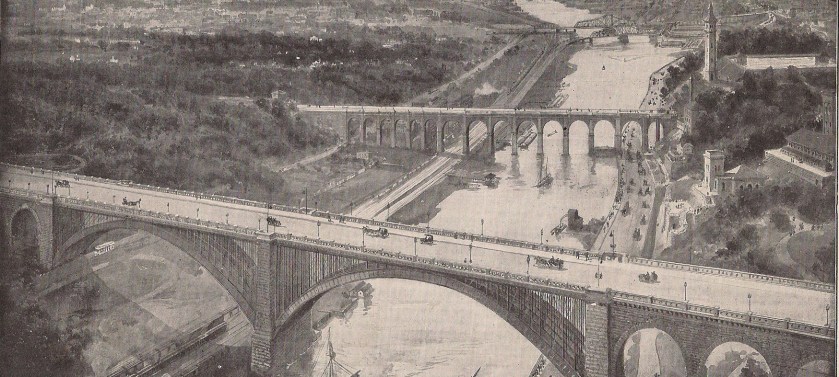
Here’s a fantastic new find!  It’s a wonderful illustrated view of the Harlem River reportedly from Fort George, which was the site of a popular amusement park that bore its name.  Beginning in the foreground is the Washington Bridge and then, continuing south is the High Bridge, followed by what I believe is the no-longer extant Putnam Bridge, and ending with the distant Macombs Dam Bridge.  King’s View of New York was one of several popular guidebooks by editor and publisher, Moses King, during the late 19th and early 20th centuries.

Harlem River from Fort George (King's Views of New York), 1915

Harlem River from Fort George (King’s Views of New York), 1915

This image was reprinted in color and sold as postcards too!